

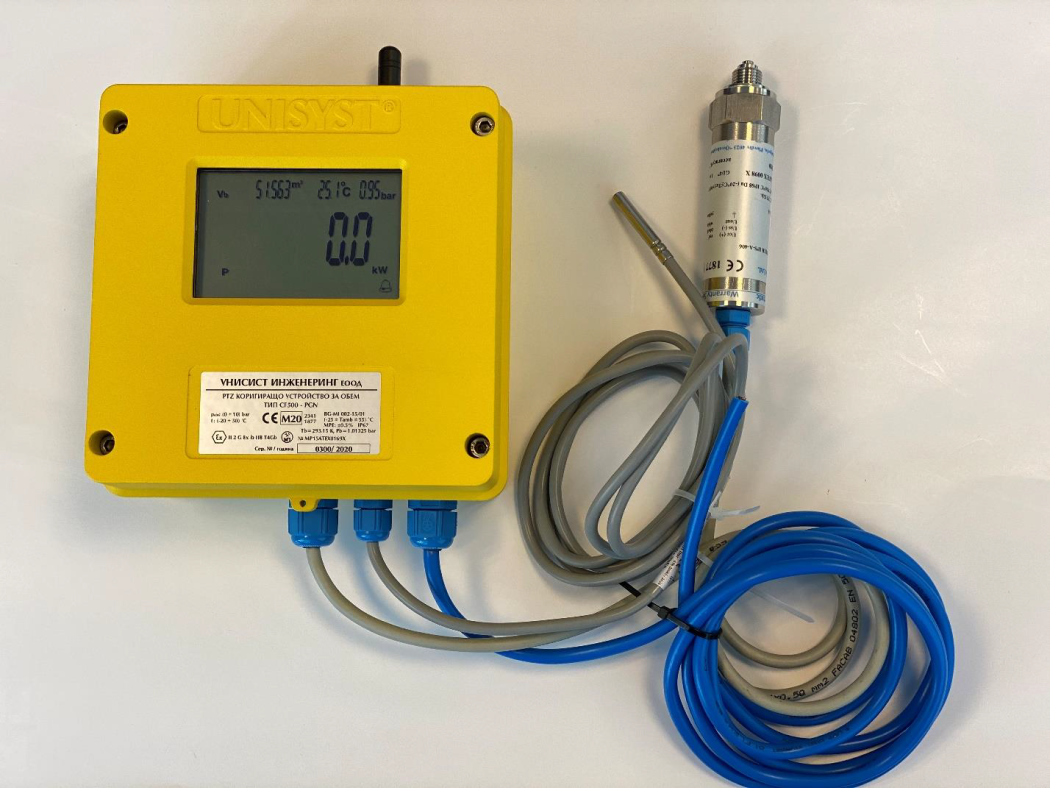
The CF500 combines measurement and calculation functions with data archiving, alarm management, and local and remote communication capabilities. The device is intended for natural gas metering stations and installations requiring accurate gas measurement, monitoring of operating parameters, and data exchange with external acquisition and processing systems.
How does the CF500 electronic gas volume corrector work?
The volume of natural gas varies depending on the temperature and pressure under which it is measured. Therefore, the quantities recorded by a gas meter must be converted to specified base conditions to ensure consistent reporting and subsequent data processing. The CF500 performs this conversion using calculation algorithms corresponding to the selected device configuration.
Differences between T, PT and PTZ volume correction
T gas volume corrector: Performs temperature-based correction of measured gas volume using specified pressure and compressibility conditions.
PT gas volume corrector: Uses measured temperature and pressure to convert gas volume to base conditions.
PTZ gas volume corrector: Accounts for temperature, pressure and the gas compressibility factor, providing a more comprehensive representation of the gas properties during volume conversion.
In its PTZ configuration, the CF500 supports several methods for calculating gas compressibility, including modified AGA NX19, SGERG 88 and AGA8-92DC. A fixed Kz compressibility factor can also be used. The appropriate method depends on the gas properties and the technical requirements of the metering system.
The CF500 electronic volume corrector is equipped with flash memory, allowing firmware updates via a laptop without modifications to the electronic circuit board. This simplifies maintenance and the installation of new firmware versions.
Main functions of the CF500 gas volume corrector
In addition to gas volume correction to base conditions, the CF500 provides functions for processing, storing and accessing measurement information. The device records both current operating parameters and accumulated gas quantities, enabling consumption monitoring over defined periods. The main functions of the electronic gas volume corrector include:
- Parameter measurement: Acquisition of gas temperature, pressure and volume data from the corresponding sensors and inputs.
- Gas volume correction: Calculation of the correction factor and conversion of measured gas volume to base conditions.
- Instantaneous flow rate calculation: Determination of uncorrected and corrected natural gas flow rates.
- Energy calculation: Calculation of energy values expressed in kWh or GJ.
- Volume totalizers: Recording of accumulated gas quantities for monitoring and reporting purposes.
- Measurement data archiving: Storage of hourly, daily and monthly records.
- Alarm and event management: Recording of deviations, alarm conditions and events related to device operation.
- Local and remote data reading: Access to measurement information through the device display or available communication interfaces.
The CF500 provides storage for 400 hourly records, 400 daily records and 132 monthly records. The archived information can be used to verify recorded gas quantities, track changes in measurement parameters and analyze the operation of the gas metering station.
Communication interfaces and remote gas metering
The CF500 is available in several communication configurations. Depending on the application, the device can be equipped with GSM communication or an RS485 interface supporting the Modbus RTU protocol. A version without communication ports is also available.
The GSM version enables remote data exchange, while the RS485 interface allows connection to compatible measurement data acquisition and processing systems. These options make it possible to incorporate the gas volume conversion device into different natural gas consumption monitoring architectures.
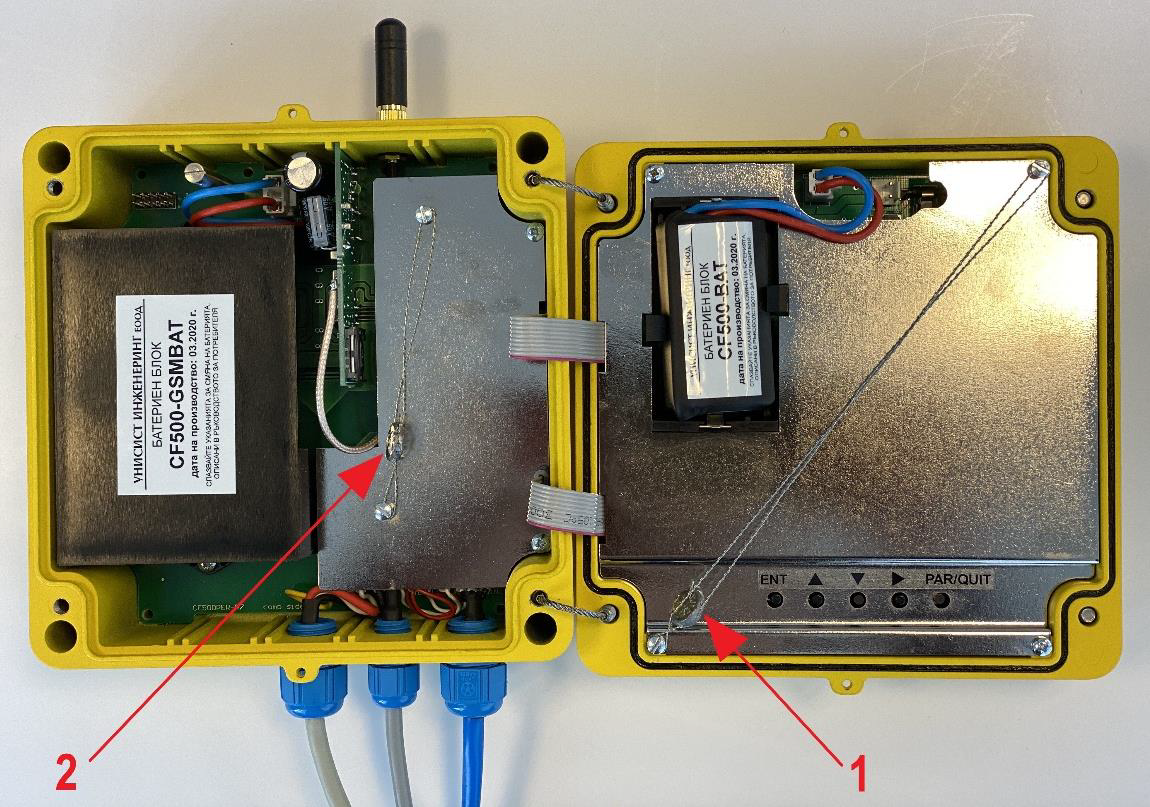
The CF500 is powered by an internal 3.6 V DC battery with a capacity of 17 Ah. The GSM version includes an additional 4.5 V DC internal battery. For the RS485 configuration, the external CF500-POW power supply and protective barrier module provides a 5 V DC supply and protection for communication lines A and B.
Selecting and configuring the CF500 gas meter volume corrector
When selecting a gas meter volume corrector, the characteristics of the metering equipment and its operating conditions must be considered. Important parameters include the operating pressure range, the characteristics of the gas meter pulse output and the required accuracy of volume conversion. It is also necessary to determine whether the metering station will operate independently or be connected to a remote data acquisition system.
The CF500 receives measured volume information through a low-frequency pulse input, making compatibility with the installed gas meter an important selection criterion. The pressure sensor must be selected according to the installation's operating parameters, while the appropriate gas compressibility calculation method depends on the natural gas properties and applicable measurement requirements.
For installations requiring remote reading, the communication interface, power supply arrangement and compatibility with the existing infrastructure must be specified. In potentially explosive atmospheres, the relevant explosion protection and safety requirements must also be taken into account.
This approach allows the T/PT/PTZ volume corrector to be configured according to the actual operating conditions of the metering station, avoiding unnecessary components and functions that are not required for the specific application.
Main technical specifications of the CF500
When selecting the CF500 gas volume converter, particular attention should be paid to its measurement ranges, gas meter compatibility and operating conditions. Temperature measurement is performed using a Pt1000 Class A sensor in accordance with EN 60751, available with a cable length of 0.80 m or 2.50 m. Absolute pressure measurement options cover ranges of 0–10 bar, 3–20 bar and 0.8–2 bar. The permitted gas temperature range is −20 °C to +50 °C, while the low-frequency volume pulse input supports frequencies up to 2 Hz.
The pressure sensor features a stainless steel housing with an IP66 protection rating. The electronic gas volume corrector itself has an IP67 protection rating in accordance with EN 60529 and is designed to operate at ambient temperatures from −25 °C to +55 °C. For applications in potentially explosive atmospheres, the device carries the ATEX classification II 2 G Ex ib IIB T4 Gb.
The CF500 is a Type 1 device in accordance with EN 12405-1, with metrological conformity under the Measuring Instruments Directive (MID). The applicable European directives are 2014/34/EU (ATEX), 2014/32/EU (MID) and 2014/30/EU (EMC). These specifications must be considered in relation to the technical requirements of the gas metering station, including installation conditions, operation and metrological control.
For further technical information, assistance in selecting the appropriate configuration or inquiries about the CF500 natural gas volume corrector, please contact the Unisyst Engineering team.
Frequently asked questions
Which gas meters are compatible with the CF500?
The CF500 uses a low-frequency pulse input supporting frequencies up to 2 Hz. Compatibility with a particular gas meter depends on the characteristics of its pulse output and the technical requirements of the metering system.
Is the CF500 suitable for installation in potentially explosive atmospheres?
The CF500 carries the ATEX classification II 2 G Ex ib IIB T4 Gb. Its suitability for a specific hazardous area must be assessed according to the installation conditions, equipment marking and applicable safety requirements.
Can the CF500 firmware be updated?
Yes. The device is equipped with flash memory, allowing a new firmware version to be installed via a laptop without modifying the electronic circuit board.