

Thermal energy calculator CF600W
Heat meter CF600W
(with assessed conformity of the type by MID Directive 2014/32/EU)
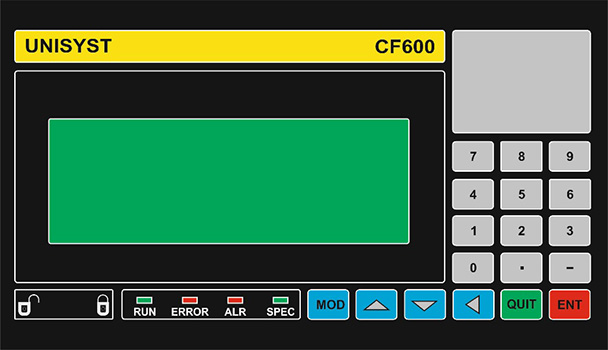
The CF600W calculator is a thermal energy measuring device designed to receive signals from the flow meter and the temperature converter. It calculates and displays the consumption and the amount of heat. The CF600W calculator works with flow meters mounted on the inlet/outlet of the heat exchange circuit.
The CF600W is a microprocessor device with an alphanumeric liquid crystal display, keyboard, analog and digital input and output channels, and RS232 or RS485 serial connection channels. Using the display and the keyboard, the device can be put into operating mode, showing the input values, the current and integrated values of the consumption, or into configuration or calibration modes.
Technical description
Volume measurement
Depending on the type of flow meter, the type of calculator is determined:
- CF600W T1 - the flow meter has a current output of 4–20 mA, proportional to the flow (e.g. ultrasonic, vortex, etc.);
- CF600W T2 - the flow meter is a orifice device with one or two transmitters for differential pressure;
- CF600W T3 - the flowmeter has a high-frequency pulse output proportional to the flow (ultrasonic).
Temperature measurement
for water heat carrier:
The inlet and outlet water temperature is measured with a pair of four-wire resistance thermometers type Pt100,
- for water temperature from Θmin 0 ºС to Θmax 150 ºС
- for temperature difference from ΔΘmin 3 K to ΔΘmax 80 K
for steam heat carrier:
The temperature is measured with a resistance thermometer, four-wire connection or with a resistance thermometer with a transmitter with an output signal (4-20) mA, and the maximum temperature can be 600 ºС.
General description
The device has four analog and one discrete input, which are galvanically separated from the rest of the device.
Analog input channels are designed to measure input values. They work with a unified current signal of 4-20 mA or a resistance thermometer directly connected by a four-wire circuit. The type of input channels is determined upon request.
For all CF600W types, temperatures t1 and t2 (for water) or temperature and pressure (for steam) are measured at analog inputs 1 and 2. Different values are measured on analog inputs 3 and 4 depending on the type of calculator:
- For CF600W T1 at analog input 3 the volume flow rate F is measured, and at input 4 a second volume flow rate F2 or pressure p (informative);
- For CF600W T2 at analog input 3 the differential pressure Δp1 is measured, and at input 4 a second differential pressure Δp2 or pressure p (informative);
- For CF600W T3 analog inputs 3 and 4 are not measured.
CF600W T1 and CF600W T2 can work with one or two transmitters for flow (volume or mass) or differential pressure. When configured to operate two transmitters, the first must have a shorter range than the second. In configuration mode, a switching limit of the transmitters is defined, which must be within the range of the first transmitter. When the second transmitter is damaged or the value measured by the first transmitter is less than the set limit, the volume is calculated with the value measured by the first transmitter. When the first transmitter is damaged or the value measured by it is greater than the set limit, the volume is calculated with the value measured by the second transmitter.
The signals from the input channels are digitally converted and checked for normal operation. If any of them is outside the normal range of the transmitter, it is considered that a sensor alarm has occurred, which is signaled and the device starts operating with one nominal constant value. This allows the calculation and accumulation of the volume to continue in the event of a fault in the transmitters or connecting cables. The nominal value is determined by statistics for the given channel.
If the device is CF600W T2, no upper sensor alarms are signaled at the differential pressure inlets. If both differential pressure transmitters have a lower sensor alarm, the consumption is calculated with the nominal value of the second differential pressure input. The same applies to the volume inputs if the device is CF600W T1. The input signals are converted into physical quantities and it is checked whether they are in the range determined by the technological emergency limits, defined in the configuration mode. Violation of any of these limits (technological alarm) only triggers the alarm signal.
The discrete inputs have an internal power supply and a common minus pole for connecting outputs of the type "open collector" or "dry contact".
The device has two discrete output channels. Each of them can be used to turn on an external electromechanical counter. The two outputs are galvanically separated from the rest of the device and from each other.
The device has a unified analog output 0(4)–20 mA, to which the volume, mass or energy consumption can be applied. The analog output is galvanically separated from the rest of the device.
The device has two serial interface channels RS485 or RS232. The first allows you to read information and to configure the device, and the second is read-only. The two interfaces are galvanically separated from the rest of the device.
The device has two electromechanical counters. Each of them can receive impulses corresponding to the volume, mass or energy consumption with different weighting factors selected by the user when configuring the device.
The calculation of the current volume, mass and energy consumption is performed according to the formulas described in the instructions. The required specific volume, the specific enthalpies and the thermal coefficient are evaluated according to EN ISO 1434.
The consumption is calculated in (l/h) - volume, in (kg/h) - mass, in (MJ/h) - energy, and the quantities are accumulated in (l) - volume, in (kg) - mass, in (MJ) - the amount of heat. They can be indicated in other dimensions specified during configuration.
The calculated values are accumulated in the memory of the device (with a built-in battery) for each hour, batch, day, month and total volume so far. The memory allows you to save the volume for the last 180 months, the last 400 days, the last 200 shifts, the last 1600 hours, as well as the maximum values for hour, batch, day and month. There is also an additional archive of 10 records, the backup time of which is set during configuration.
The device's built-in software allows it to be configured and calibrated. Configuration parameters and calibration factors are stored in non-volatile memory.
Operational and system tests are included in the software. The operational tests monitor the reliability of the input channels, and the system tests monitor the reliability of the device (memory, ADC, real-time clock, etc.). When a fault is detected, the alarm output is switched on and the generated alarm is archived and visualized. After confirmation by the keypad, the alarm output is switched off.
Technical data
- Mechanical class: M2;
- Environmental class C: 5 ºС to plus 55 ºС;
- Electromagnetic class: E2;
- Degree of protection - IP 65.
Measuring ranges
The measuring ranges are determined during the configuration of the device.
- The maximum values of the instantaneous consumptions are 999 999 in the dimension selected during the configuration;
- Maximum value of heat output: Ps = 120,000 kW
- Bit count of the electronic counters in the dimension selected during the configuration:
- integrated consumptions for periods (hour, batch, day, month): 9,999,999,999;
- total integrated consumptions: 99,999,999,999.9;
- Hours meter count: 999 999 hours and 59 minutes.
Power supply
The power supply is from a single-phase zero network 90-264V/47-63Hz (maximum power consumption 60VA) and 11-30 V DC.
Size
- Dimensions 213x180x100 mm;
- Weight: 1 kg.
Work conditions
Normal conditions:
- Temperature: 23 °С ± 2 °С;
- Atmospheric pressure: 86–106 kPa;
- Relative humidity: 60% ± 15%;
- Supply voltage: 230 V AC, 50Hz and 12-24 V DC;
- Initial settling time: 30 min.
Working conditions:
- Temperature: 5 ºС to plus 55 ºС;
- Atmospheric pressure: 86 to 106 kPa;
- Relative humidity: up to 80% / 25 °С.